
We are a computational chemistry research group based at the University of Southampton working under the supervision of Prof. Jonathan Essex.
Our research revolves around the application of the theoretical techniques of statistical thermodynamics and quantum mechanics to the study of organic and biomolecular systems.
Our aim is to rationalise and intepret experimentally observed behaviour at the molecular level, and suggest further lines of experimental inquiry. This work is of direct relevance to rational drug-design and we collaborate extensively with the pharamceutical industry.
Some recent publications and software releases from the group. A full list of publications and software packages are also available.
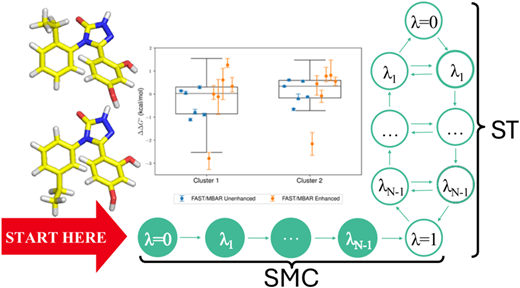
Journal of Chemical Theory and Computation, 22(15), 7993-8012
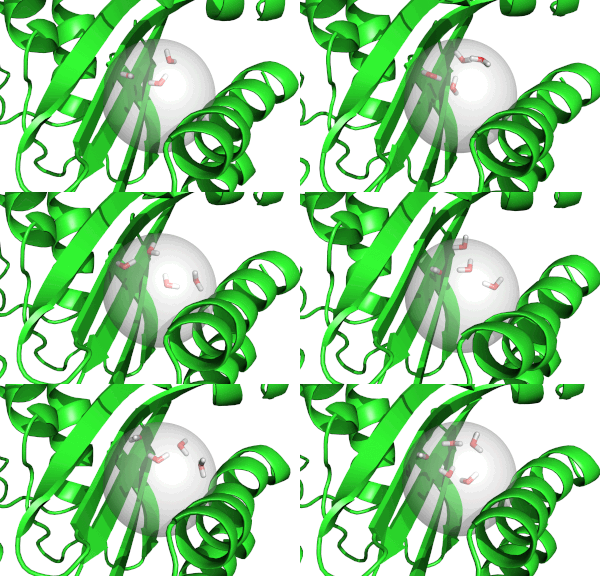
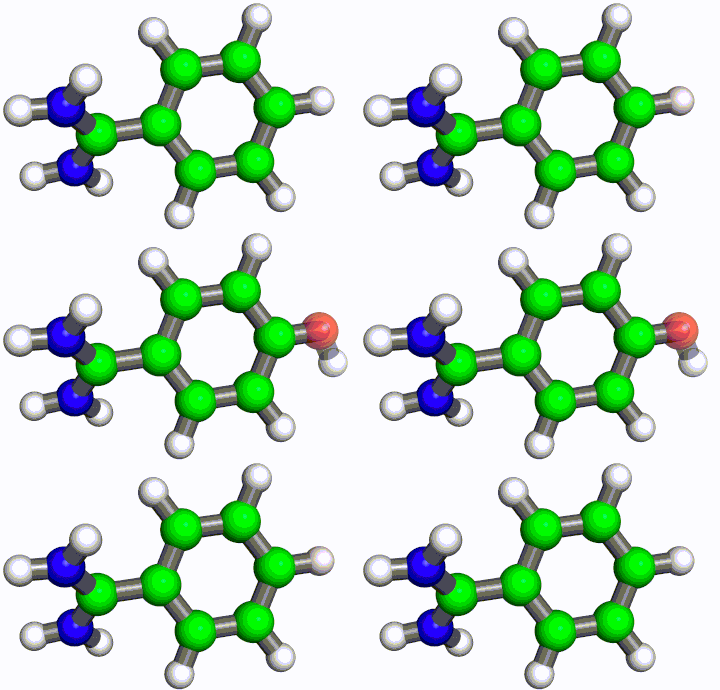
Alchemical free energy (AFE) calculations are a useful tool in computational drug discovery. However, they typically involve relatively short (<10 ns) simulations, meaning that the initial coordinates and, more generally, the setup of the system have a significant effect on the obtained free energy values. To remedy this, we recently developed a fully adaptive version of the simulated tempering algorithm (FAST) and applied it in the context of sampling. In this work, we extend FAST to AFE calculations with and without enhanced sampling of a particular degree of freedom of interest (FAST/MBAR). We show that enhanced sampling significantly increases the mobility of the targeted degree of freedom at the cost of reduced sampling efficiency over λ space. On the other hand, the free energy calculations without explicit targeting of certain degrees of freedom retain initial-coordinate bias over longer time scales. Despite this, both protocols readily explore nanosecond-time-scale events, such as torsional rotation, due to the single-trajectory nature of FAST, making them less sensitive to the system preparation. It is shown that the robust automated nature of FAST/MBAR makes it a competitive alternative to conventional AFE methods.
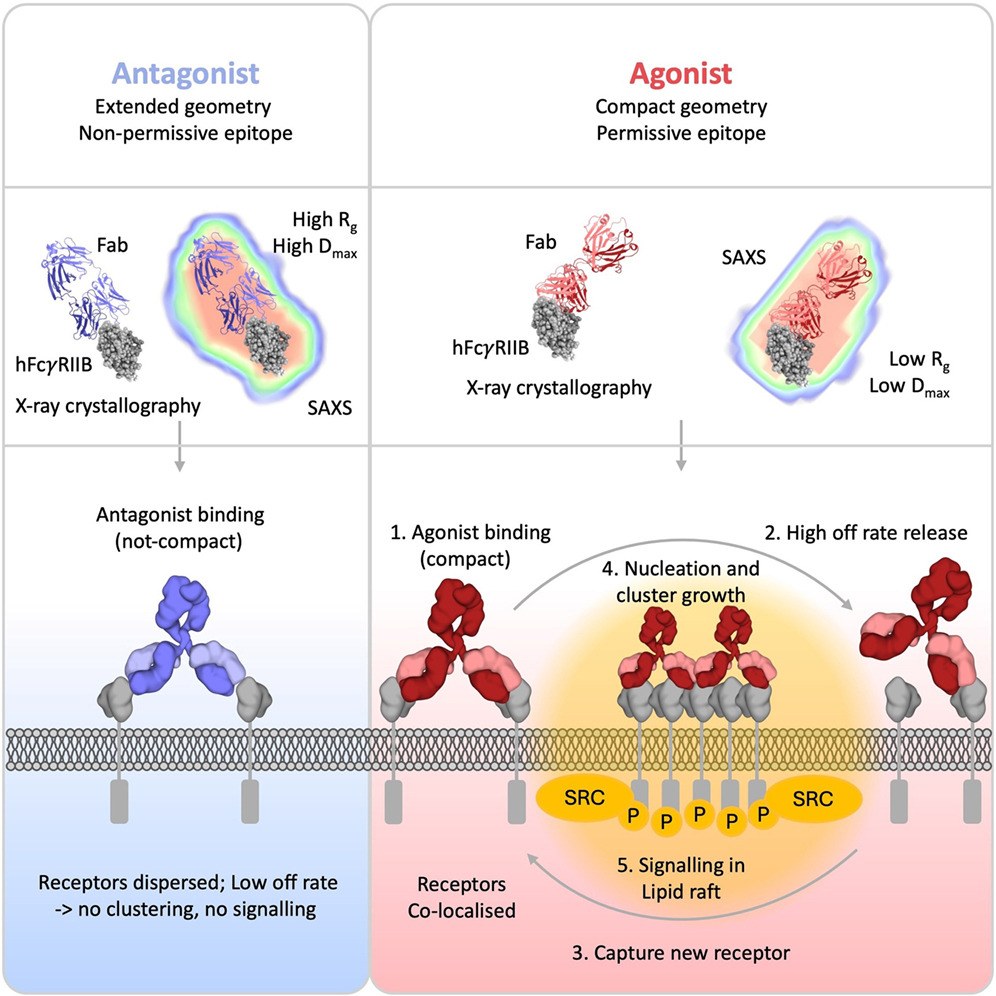
Immunity, 59(7), 2041-2052.e7
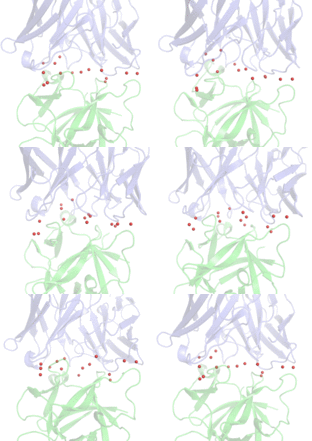
The inhibitory human Fc gamma receptor, hFcγRIIB, is a key mediator of humoral immunity and regulator of antibody-mediated effector function. hFcγRIIB function can be modulated by anti-hFcγRIIB antibodies. We demonstrate that agonistic, but not antagonistic, antibodies reduce hFcγRIIB mobility in the plasma membrane, associated with receptor clustering and redistribution into lipid rafts. Agonists display lower affinity binding with higher off rates compared with antagonists. Using crystallographic structure determination and alanine-scanning mutagenesis, we show that epitopes targeted by agonistic and antagonistic antibodies are overlapping but distinct. Using small-angle X-ray scattering (SAXS) and molecular dynamics simulations, we demonstrate that agonists nucleate more compact receptor complexes. Through their high off rates, we propose that agonists facilitate a catch-and-release mechanism that promotes receptor clustering and subsequent activation. By contrast, antagonists adopt a binding geometry that prevents effective clustering, with their low off rate reducing receptor disengagement and subsequent clustering. These findings provide key principles underpinning agonism versus antagonism of immunomodulatory receptors.

British Journal of Cancer, 134(9), 1352-1359
Background Multicystic mesothelioma (MCM) is a rare disease and there is debate about it’s neoplastic nature with a spectrum of disease behaviour and little known about the genomic profile. In contrast, the genomic profile of malignant peritoneal mesothelioma (MPeM) is characterised. Methods We characterized 24 MCM and 18 MPeM cases across a panel of cancer related regions and expanded to whole-exome sequencing for 11 MCMs. Validation by amplicon sequencing and functional assessment by molecular dynamic simulation were carried out. Kaplan-Meier analysis was carried out to assess recurrence-free survival. Results Few mutations were identified in MCMs across the panel. Exome sequencing revealed 28 genes mutated in >1 MCM case. We saw significant overrepresentation of mutations in the cohesin complex in SMC3 , SMC1A , and STAG3 . Multiple mutations in SMC3 at codon p.E1144 indicated a mutational hotspot. Molecular dynamics simulations showed mutation at this site impacts the protein function. Amplicon sequencing confirmed hotspot mutations in further MCMs. We observed a significant association ( p = 0.0302) of mutation in SMC3 or SMC1A with disease recurrence. Conclusions We see recurrent somatic mutations in MCMs particularly at a novel mutational hotspot in SMC3 , consistent with a neoplastic process. Mutations in cohesin complex genes are associated with disease recurrence.
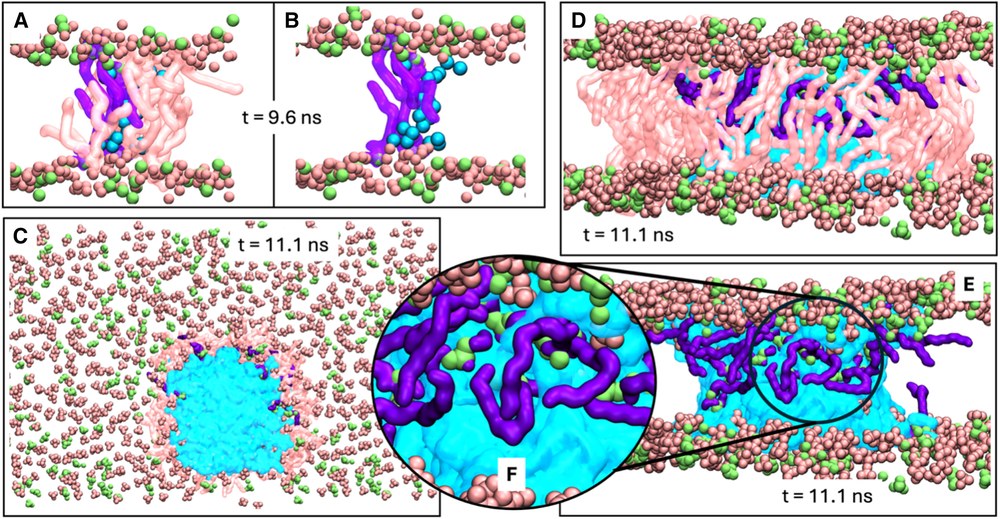
Biophysical Journal, 124(19), 3227-3243
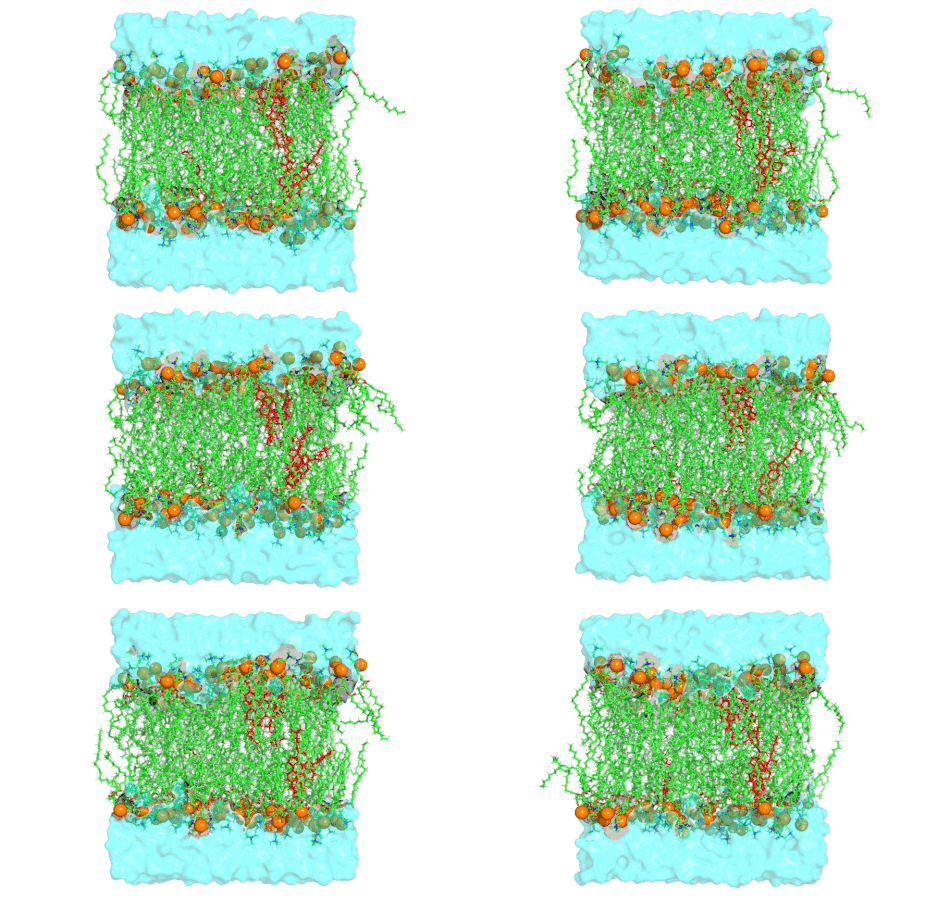
Lysophospholipids are an important class of lipids in both prokaryotic and eukaryotic organisms. These lipids typically constitute a very small proportion (<1%) of the bacterial lipidome but can constitute 20%-45% of the Campylobacter jejuni lipidome under stress conditions. It is thus of importance to include these lipids in model C. jejuni membrane simulations for an accurate representation of the lipidic complexity of these systems. Here, we present atomistic models for four lysophospholipids from the C. jejuni lipidome, each derived from existing phospholipid models. Herein, we use molecular dynamics simulations to evaluate the ability of these models to reproduce the expected micellar, hexagonal, and lamellar phases at varying levels of hydration. Mixtures of phospholipids and lysophospholipids emulating the C. jejuni lipidome under ideal growth conditions were found to self-assemble into bilayers in solution. The properties of these mixed bilayers were compared with those containing only phospholipids: the presence of the selected lysophospholipids causes a subtle thinning of the bilayer and a reduction in area per lipid, but no significant change in lipid diffusion. We further test the mixed bilayer model running simulations in which a native inner membrane protein is embedded within the bilayer. Finally, we show that lysophospholipids facilitate the formation of pores in the membrane, with lysophospholipid-containing bilayers more susceptible to electroporation than those containing only phospholipids.